
An Introduction to Grammarly
Grammarly is an online grammar checking tool used by countless students and writers to check their content for spelling mistakes, clarity, and consistency. It can also detect plagiarism and offers alternative word choices to improve the quality of your work.
As marketers, having proper grammar may not directly increase conversions on your landing pages, but having poor grammar and low-quality writing can certainly hurt your conversion rate.
A study by Global Lingo revealed 59% of people would not use a company that had obvious grammatical errors and spelling mistakes on its website or marketing materials.
Grammarly is a tool that gives autonomy to the small business owner and saves them money in the long run. If you can’t afford a proofreader – or would prefer to remain self-sufficient – Grammarly makes for a great addition to anyone’s toolbox.
[tweetthis]Using email campaigns to drive people to landing pages is a strong strategy to generate sales.[/tweetthis]
Defining Moments
Grammarly was founded in 2009 by Alex Shevchenko and Max Lytvyn and has grown to one of the most renowned proofreading services in the writing world. They reached number 55 of the Deloitte’s Technology Fastest 500, fastest growing businesses in North America in 2014, and are still growing rapidly.
The company switched to a freemium model in 2015. Drew Price, Head of Product Marketing for the company said, “the company is focused on providing a sticky and powerful free version while making users aware of the expanded functionality available through Premium.” This is reflected in their email marketing by using carefully selected statistics and adding value where they can without trying to shove their paid product in users’ faces.
The company takes exactly the right approach to email marketing – not trying to go for the quick sell before forming lasting connections with users. This is summed up in Drew’s advice to other marketers, “think long-term. Think of creating an optimal relationship.”
Drip Campaign Email Examples
Nurture Campaign
Nurture campaigns are the most important drip campaigns you can run when it comes to the success of your business. Theses campaigns take potential leads and guide them towards parting with their cash and buying your product.
Every nurture campaign will be slightly different depending on your business model. Grammarly offers a free text editor which you can download, a browser extension and a premium service. If users only download the free text editor, Grammarly’s first goal is to get them to download their browser extension and then they move onto nurturing their paid premium service.
Let’s look at some of the emails from one of Grammarly’s nurture campaigns.
Welcome Email
Welcome emails are the most important email in your nurture campaign and maybe your entire email strategy. They are your first point of contact with potential customers, and first impressions are crucial.
As Entrepreneur eloquently put it, “opportunity knocks once in an inbox.” In a report by Return Path, their open rate was found to be 42% higher than other promotional emails. Make this exposure count!
Below is a welcome email you receive if you download the free text editor:


Pros
- According to Convince and Convert, 35% of readers will open an email based on subject line alone. Grammarly’s line is effective – “Congratulations” emphasizes the value of the email as it makes the reader feel like they have gained something. It also adds scarcity as it implies they are getting access to something that is not available to everyone. The word “free” encourages the reader further to open as they know they are getting something for nothing and are not obliged to purchase anything.
- As part of a successful nurture campaign you must add value for your readers, show that you give formidable customer service and make the user experience smoother than silk. Grammarly enhances user experience from the start by giving the reader suggestions of features to try out in the very first email like Grammar Cards, Custom Dictionary, and more.
- Digital Branding Institute stresses the importance of a clear call-to-action in all of your emails. “An effective CTA helps to encourage your subscribers and increase conversions.” Grammarly’s call-to-action button is bold in red and does exactly as advertised – it takes you straight to the text editor.
Cons
- The number one rule of permission based marketing is that you add value for the reader before you ask the user to part with any money. Grammarly may drive away potential customers by offering the chance to “Go Premium” from the outset.
Newsletter Opt-In

Pros
- The subject line for this message is strong. It tells the reader exactly what they are going to get.
- A lot of companies add users to their newsletter lists without asking permission. But giving them an opt-in has its advantages, as pointed out by Vero, “If Grammarly added new users to the newsletter by default, they’d water down their own product by adding noise to the inbox. The opt-in request provides a cleaner experience and fosters a trusting relationship in the process.”
- The best way to cultivate a relationship with readers is to use a conversational tone. The casual language “brand spankin’ new” and “chock full” helps to connect with the reader.
- The call-to-action is clear, again highlighted with the red color. The phrase supporting the button, “click to get added to the list” has a handwritten font, which supports Grammarly’s branding as a company that is all about improving your writing.
Cons
- I can’t actually find anything wrong with this email – way to go Grammarly. Short and sweet with a clear subject line. If anything, the gray text on a dark background may be difficult for some readers to see. On the other hand, it does draw attention the red CTA button.
Browser Extension Download
Once Grammarly has added some value for the reader they start to try and influence their behavior.


Pros
- Although I blacked it out for example purposes, my name was included at the top of this email which contributes to the conversational tone of the message.
- Writing copy for the internet is a different beast to most other mediums because reader’s attention spans are so short. Enchanting Marketing nails it by saying, “Web copy is scanned. Or glanced at. Not read.” Using lots of sub-headings and short paragraphs helps to get around this. Grammarly follows the rules perfectly in this message. The reader can see the benefits of getting the browser extension – works across web, saves time, etc. – at a glance.
- The call-to-action is clear, emphasized by putting it twice.
Cons:
- Repeating the call-to-action is a double-edged sword because shoving it in your reader’s face too many times may be seen as pushy and could put them off.
[tweetthis]Grammarly takes the right approach to email marketing – they don’t go for the quick sell before forming connections.[/tweetthis]
Re-engagement Campaign
Re-engagement campaigns can be the saving grace for users who are having second thoughts about your product. It’s all about getting the campaign to the right people at the right time. Grammarly’s re-engagements are triggered based on a number of factors including how much text has been checked by users, and which version of the product they are using.
Let’s have a look at some emails from their re-engagement campaigns.
Re-engagement Email #1:
Below is an email sent to premium users who have not used Grammarly in the past week:


Pros
- This email is highly effective. Personalized statistics and writing hints and tips are a nice bribe of added value to get users to re-engage. If a user does not re-engage after receiving this message Grammarly can move the user along the funnel perhaps sending offers or more added value to tempt them back.
- Again, adding the reader’s name adds to the conversational tone of the message.
- The concerned tone of the message helps to demonstrate excellent customer service. Grammarly wants to provide the best possible user experience to the reader with personalized statistics.
- The clever wordplay with, “welcome” and “welcomed” helps to intrigue the reader into clicking, learning more, and subscribing to Grammarly’s newsletter.
- The “Where you’re protected” section is a nice touch. Most people will notice the clever use of the on/off toggles. Some antivirus apps also use similar toggles. It shows how seriously Grammarly takes bad grammar and their commitment to helping users cut it out of their writing.
Cons
- It’s only been a week and Grammarly is already marketing to their users. This carries the risk of putting users off their product, even if it’s providing value at the same time.
Re-engagement Email #2
The next re-engagement email is sent to users at the start of the funnel. Those who are just using the free browser extension.

Pros
- Grammarly makes use of an interesting psychological phenomenon explored by Customer.io where people find it more painful to lose something than to gain it. Telling the user that they may miss around 36 mistakes a day if they choose not to reactivate their browser extension in bold, large text right at the start of the email helps to drive the message home. This opening statement is then supported with more stats, and one more to add to the loss aversion: an average of 210 minutes per week saved on proofreading. Then, social proof to coax the user back on board: 500000 people using Grammarly every day and over 10,000 sites.
- A short, simple summary at the end sets the reader up to click on the clear and concise call-to-action.
Cons
- I can’t fault this email, it ticks all the boxes.
Compare and Contrast: WordRake
One of Grammarly’s competitors in the proofreading sphere is WordRake. Let’s take a look at some of their campaign emails in comparison to those already explored.
Welcome Email


And, as a reminder, here is Grammarly’s welcome email campaign:


Pros
- The call-to-action coloring is not as clear as Grammarly’s, but it does help with branding as it is one of WordRake’s corporate colors.
- Social proof is a great persuading tool. WordRake capitalizes on this by including a testimonial. Since you can download a free trial of WordRake, users may not be fully committed to the product at this stage. Building trust early on can help to nurture leads.
Cons
- The tone of the email is very negative. In contrast to Grammarly’s email where they talk about what you can do with the program, WordRake talks a lot about what you can’t do.
- The call-to-action is trying to get readers to buy the paid version of the program. This is a very bad idea. At this stage users are unlikely to have used the app for enough time to make a decision about it. Plus, they are breaking the golden rule of marketing which is to add value before you try to make a sale.
- From a design perspective, there is little contrast to the fonts in Wordrake’s message, and not much use of white space making it look busy and cramped compared to Grammarly’s – where each section is clear and given room to breathe.
Writing Tips Opt-in


And Grammarly’s

Pros
- The alliteration effect of the subject line keeps the tone light and fun. This is effective for selling proofreading as it can be a very dull subject!
- Again, WordRake makes good use of social proof with two testimonials in this message.
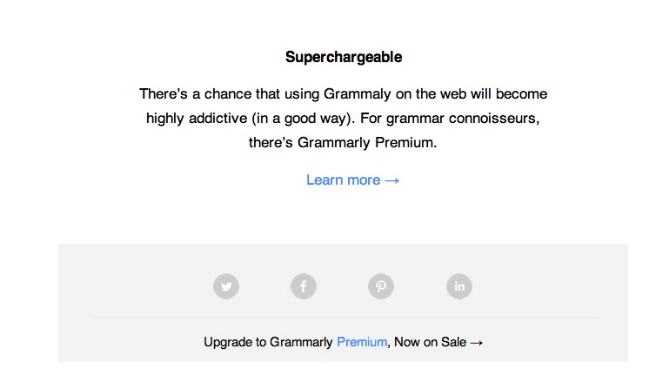
- The social sharing buttons in color makes them a lot more prominent than Grammarly’s which is more conducive to sharing.
Cons
- Visually, Grammarly’s email is a lot more appealing than WordRake’s. Plain text emails have their place, but if you’re a fan of well-designed emails, WordRake’s could use some work.
- The main orange call-to-action is clear but the two hyperlinks add to the busyness of the email and aren’t very clear at all.
Email Campaigns and Pagewiz
Using email campaigns to drive people to landing pages is a strong strategy to generate sales. But if your landing pages aren’t fully optimized, you could be losing out on revenue. Pagewiz creates stunning landing pages that come with built-in A/B testing so that you can optimize them and keep them that way. They have many built-in integrations so that you can easily send your captured leads to email service providers such as Aweber, Salesforce and many more.
Wrapping It Up
Grammarly’s freemium model means that they must tread lightly with email marketing. They execute this well with each campaign sensitive to the needs of the user. Drew Price, Head of Product Marketing sums up their ethos well, “there is no one-size-fits-all approach. Each campaign is created with a single goal in mind, based on the attributes of the target users.”
They don’t try to sell the user from the very first email, and they build well from their free product foundations.
For marketers, you can take a page out of Grammarly’s book and rely on the user’s experience of your product to gauge your marketing campaigns.
Over to you – have you picked up any new ideas after reading about Grammarly’s drip campaigns? Maybe something you plan to implement in your own marketing funnels?


Elna Cain is a professional writer living in Canada. She works closely with B2C and B2B businesses and has a background in marketing and psychology. She’s been featured on OptinMonster, Social Media Today, Blogging Wizard and is a Huffington Post contributor.
Also published on Medium.